





Important woody plant area
 GuttiferaeBignoniaceaeCapparidaceaeFlacourtiaceaeAquifoliaceaeNyssaceaeAnacardiaceaeDilleniaceaeBombacaceaeMyristicaceaeElaeocarpaceaeHelicia formosanaUlmaceaeRosaceaeAraliaceaeFabaceaeAnnonaceaeMoraceaeFagaceaeLauraceaeMagnoliaceae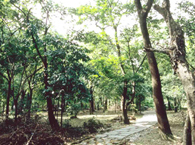
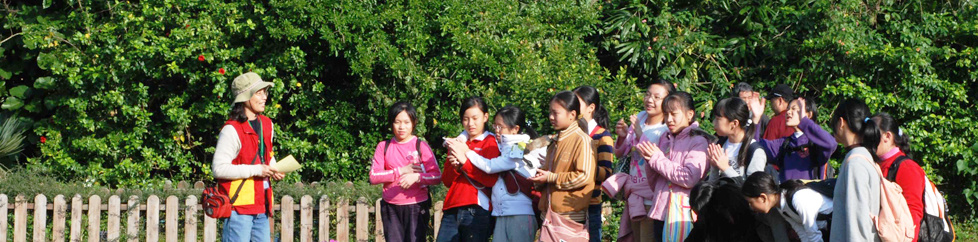
In Taiwan, the lower sea level forest has a wide variety of plants. In the first level of high arbour tree, normally it is combined with second level of lower arbour, shrubs and parkland. In important woody plants area, The garden represents a double-layer of forest based on this hierarchy to emphasize the biodiversity and to attract several different kinds of insects and animals. In this area,including Lauraceae, Moraceae, Fagaceae,Leguminosae, Rubiaceae, Rosaceae…etc several important woody plants in Taiwan,especially the Moraceae seeds are a primary food source for birds. Fagaceae andLauraceae seeds are favourite food of animals like squirrels. Although it is essentially artificial environment, the garden is a faithful representation of natural Taiwan forest life in Taiwan and offers visitors a first hand experience.

 Bignoniaceae
【Bignoniaceae plant】
The Bignoniaceae family is comprised mainly of trees, shrubs and lianas. The leaves are mostly opposite with palmate or pinnate compound leaves. The flowers are bisexual and somehow zygomorphic. The calyx is campanulate; the corolla is also campanulate and lobes markedly shorter than the tube. Fertile stamens grow alternate with anthers, mostly didynamous to tetradynamous, and the rest are staminode. The anthers are usually connivent. The capsules dehiscent loculicidally when they are mature and usually winged or with tufts of hairs at both ends.
The Bignoniaceae family grow in tropical region. Radermachia sinica is the only specie grows in Taiwan and often be found in open field. It has become a popular houseplant, grown for its decorative foliage and shadow. Many of Bignoniaceae species are ornamental plants which are collected from overseas and spread to towns. Those flowers are large and pretty, such as Trumpet trees (Tabebuia impetiginosa), Flaming trumpet (Pyrostegia venusta), African tulip tree (Spathodea campanulata) and Yellow bells (Tecoma stans) etc. Sausage tree (Kigelia pinnata) which has bloody red flowers and blossom at night which is amazing. There are about 20 species in this Garden.
UlmaceaeThe leaves of Ulmaceae plant are alternate, unlike those of most other common trees have an asymmetrical base and have two stipules which is a classical identification method during wild field observation. The Chinese had valued Ulmus genus which had a wide variety of uses. According to Han-Shu: “Meng-Tian made inroads into Hu country for Chin dynasty,established new groundfor a couple of thousand kilometres,piled up stones as town walls, leveed elms as mountain stronghold.” Elms were widely planted around impregnable bulwark as windbreak forest in that time. Why Elms were chosen? It was because of its wide adaptation to a broad range of climates and soils, rapid growth, strong wood, resistance to wind damage, and vase-like growth habit requiring minimal pruning. It grows well on loess field. The wood is resistant to decay when permanently wet while plants in river sides. It is basi-prooved (resist) which can grow on salty or alkali soils. Trema orientalis is commonly seen in Taiwan, and Hackberry (Celtis sinesis) is a major Ulmaceae species of horticultural importance in lower to middle elevation forests. Beside, including Zelkova serrata and Ulmus parvifolia are excellent timber sources from this family which have high economic importance.
RosaceaeThe Rosaceae plants are divided into various shapes from shrubs, trees and perennial herbaceous plants. The leaves are simple or compound, petiole usually 2-glandular apically, leaf blade often serrated at the margins, rarely entire. There are 5 sepals and as many petals, but stamens are usually numerous. Female flower carpels have numerous shapes. The fruits have many types, such as follicle, pome, achene, or drupe. Many of important fruit trees, such as Peach (Prunus persica) or Plum (Prunus family), are famous flowering plants world wide which have certain ornamental usage and are valued for cultivation.
There are several Rosaceae original species in Taiwan, also including rare species which have educational, research and economic value for cultivation. The perennial herbaceous Rosaceae plants are exhibited in the Taxonomic Garden.
AraliaceaeThe Araliaceae family includes mostly in tropical trees and shrubs, some lianas and perennial herbaceous plant, mostly have thorns. The flowers are small and occurring in terminal umbel or capitulum inflorescence. Many of Araliaceae family are used for their medicinal properties, such as: Acanthopanax gracilistylus, Acanthopanax senticosus,Panax notoginsengetc.
Ginseng is the most well known. In others, the Araliaceae is in the main character of Taiwan economic development, for example: Tetrapanax papyriferus in years of drought was an important packing pad material before Styrofoam was created; Schefflera arboricola is a comprehensive ornamental plant for indoor or outdoor use.
FabaceaeThe Fabaceae plant contains some of the most valued food crops in agriculture, important sources of vegetable protein and oil. Many species have high economic value and they are used as animal feed or green manure, medicinal properties and yield important substances like resins, gum arabic, tannin, dyes, timber, fibre, fuel, ornamental trees and nectar sources etc.
The Fabaceae is sliced less than the Gramineae, has maximum usage species. A significant characteristic of legumes is that they host bacteria in their roots, within structures called root nodules. These bacteria known as rhizobia have the ability to take nitrogen gas out of the air and convert it to a form of nitrogen that is usable to the host plant. This process is called nitrogen fixation. The legume, acting as a host; and rhizobia, acting as a provider of usable nitrate, form a symbiotic relationship. Based on this specified character, legumes can enrich poor land.
AnnonaceaeThe Annonaceae family consists of woody trees like the Magnolia family but still maintains most of its original characteristic marks. For example, helically disposed stamens and several to many simple pistils; the stamens consist of the fertile central anther portion, a distal pad of fleshy connective tissue, and a short fleshy basal portion.The pistils each have a superior ovary with one locule and 1-many parietal ovules which are more developed than the Magnolia family. The pistils generally remain distinct and develop into berry-like fruits but sometimes they coalesce into multiple fruits like the aggregate fruit.
This family is one of the best educational examples of botanical evolution. Some varieties are of on important economic performance, such as Custard apple trees (Annona squamosa), famous delicious fruit trees and Ylang-ylang trees (Cananga odorata) for refined essence materials (essential oils) etc.
MoraceaeThe Moraceae plant is of horticultural importance in lower elevation forest and also in biological society, for example: the fruits on Ficus wightiana or other Ficus family and mulberry are important food source for birds. Those society insects in abundance appear by seasons, such as various Asota families; the hornworm likes the leaves of Ficus genera such as Ficus fistulosa or Ficus erecta. Also people like the special flavour Moraceae fruits,such
as Jack fruit tree (Artocarpus heterophyllus), Lakoocha (Artocarpus lakoocha), Bread fruit (Artocarpus altilis) and Jelly fig (Ficus pumila) etc.
The paper mulberry (Broussonetia papyrifera) has a high economic value; the leaves are a good source for deer, and its bark fibres make excellent paper pulp material. This garden collected Moraceae plants from Taiwan and from overseas in order to maintain the source for future research and students practise observation. Moraceae has its important biome status in lower elevation and it is a great practical educational material based on its special life cycle, singular syconium or fleshy aggregate fruits, specially adapted flowers, breathing roots and aerial prop roots.
FagaceaeFagaceae is main material of tropical and subtropical forests. Taiwan is located in a subtropical region. The Fagaceae species have advantages in the broadleaf forest. The hard wood is good for timber utilised in house building, making furniture, boat building etc. Back to agriculture period in Taiwan, there were many tools made by the Fagaceae family, such as hoe helve, plow blade, yoke etc, especially the Castanopsis is the best hard wood source.
The seeds contain starch which is a staple source of food for people, birds andthe rodents, it is also one of main industrial starch sources, such as the chestnuts in “Marron glaces”are from Castanea.
LauraceaeLauraceae plants are mostly aromatic evergreen trees or shrubs, also parasitic vines, from tropical and subtropical regions, they contain about over 2,000 species world wide. A high content of ethereal oils are found in many Lauraceae. The leaves are simple with entire margin and usually alternate, bipinnately compound leaves or trifoliate. The flowers are tiny, indistinguishable by the petal and calyx;the colour is mostly white or light yellow,seldom red.
It usually grows in a small group along an axis or at the base of the panicle inflorescent or umbel inflorescent, even compound umble inflorescent. The androecium most frequently comprises 4 whorls of 3 stamens each; the filaments of the inner whorl usually have a pair of enlarged glandular appendages near the base. The anthers dehisce by 2 or 4 upwardly opening flaps. The fruit is a berry or a drupe, often surrounded basally by the short, persistent perianth cup or fall early enclosed a seed.
MagnoliaceaeThe Magnolia family is a famous ornamental plant world wide with aromatic flowers. It was planted in China since the Tang dynasty. There are several Magnolia gardens in every major botanical garden world wide, such as the Magnolia Garden in Huan Nan Botanical Garden (China) with a collection of over two hundred species in general; mostly in terminal blossom with long leaves which have higher ornamentedvalue than ordinary blossom with leaves.


